Sign up to be notified of our new blog posts.
Three Unique Solutions to Operational Bottlenecks
Posted on May 05, 2026
Summary: Many production bottlenecks do not require a complete system overhaul. Instead, processors can increase throughput, reduce cleaning requirements and improve production flow by making targeted changes to how vessels, ingredients and batch steps are used.
In this article, we look at three real-world examples of practical bottleneck solutions, including:
- Splitting production between high-demand and lower-demand products
- Using a staging vessel to free up main batch capacity
- Separating base processing from variable ingredients like flavors, colors or fragrance
In today’s competitive manufacturing environment, efficiency isn’t just a goal, it’s a necessity. As production demands grow and product lines diversify, many processors find that systems which once worked well begin to create bottlenecks, driving up costs and limiting scalability.
The solution doesn’t have to involve a complete overhaul, but instead can simply be finding ways to make smarter use of equipment, refining process flow and identifying where capacity is being underutilized.
Following are three real-world examples of practical, cost-effective solutions we brought to our customers who were facing these efficiency challenges, significantly improving their throughput, reducing downtime, and enhancing operational flexibility at relatively low cost.
1) Split Production Process
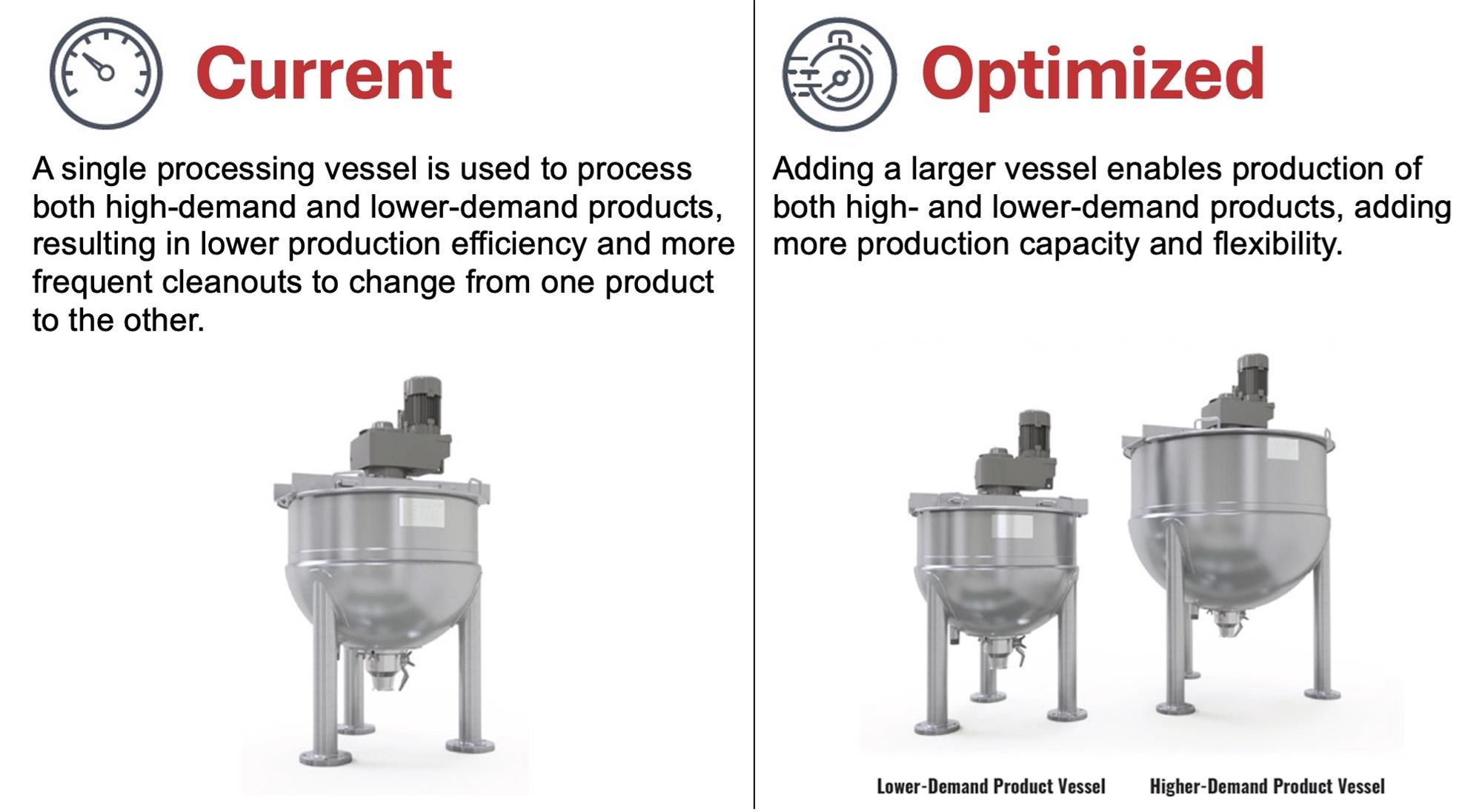
Many companies start out by processing all their products in a single batching vessel, regardless of the range of demand and production requirements. But as their business grows, that setup may no longer suffice. For example, when a top-selling product requiring production of five full batches in a 100-gallon capacity vessel per day must share capacity with a lower-selling product processed in one batch of only 50 gallons in the same 100-gallon vessel.
SOLUTION: Facing this situation, the processor split the production process by adding a second, larger 500-gallon vessel that allowed the plant operator to make a single 500-gallon batch each day of its best-selling product, and then use their current 100-gallon vessel to process its lower-demand products as needed. This solution not only increased production capacity and scalability, but decreased processing time and cleaning required, compared to sharing a single vessel.
2) Ingredient Staging Process
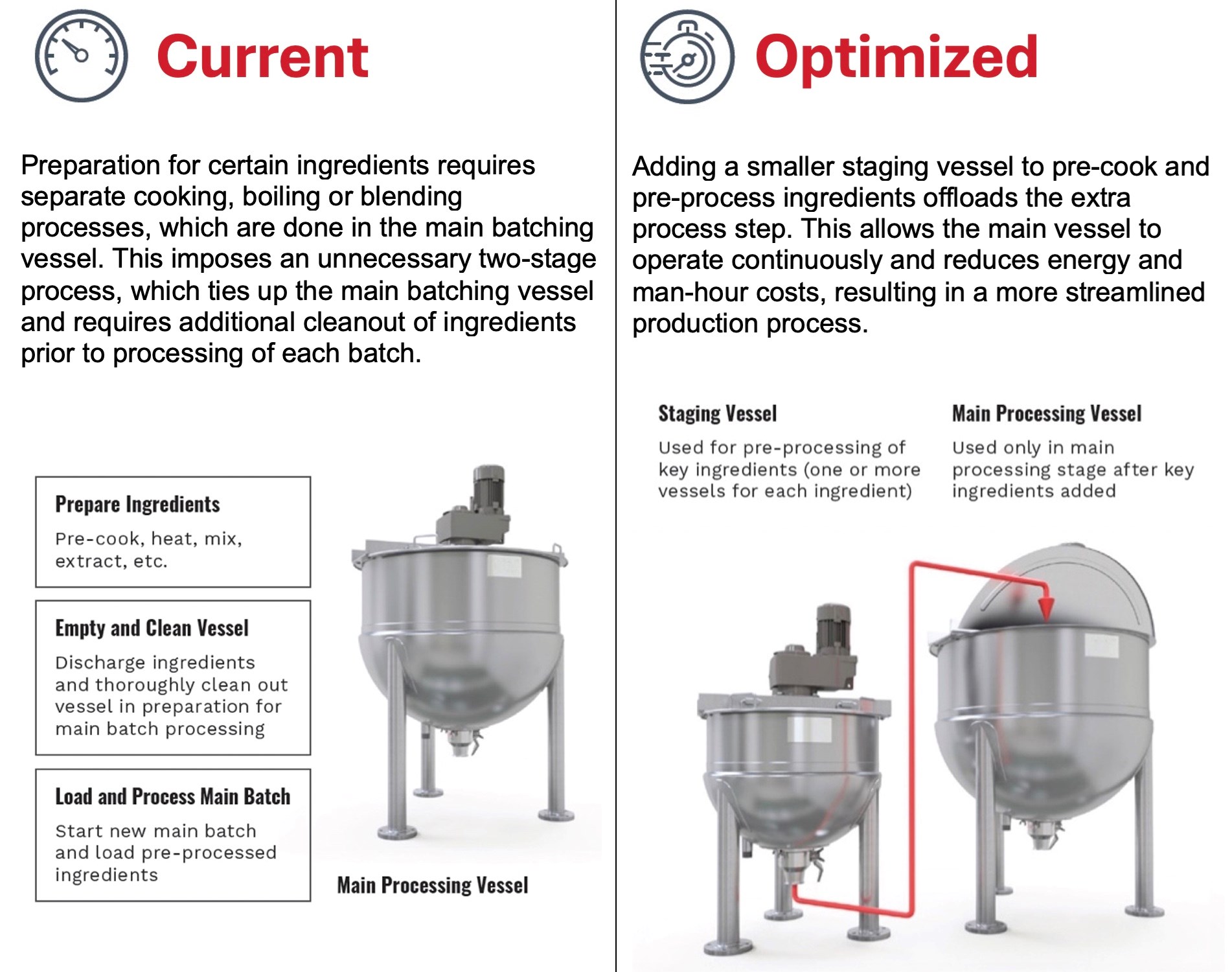
Other processes require different cooking, boiling or blending operations to be performed in the batching vessel prior to the main batch process. For example, a tomato sauce containing meat may require pre-cooking of the ground beef, which is then added to the main batch process. In a single vessel, this requires a two-step processing operation, where the meat must first be cooked, then the juices removed before adding the tomato base and other starter ingredients to begin processing the main batch.
In this case, the bottleneck occurred when the large capacity main production vessel was used to process a relatively small amount of ingredients. Specifically, using a 1,000-gallon main batching vessel to process only 200 gallons of one of the ingredients prior to the main batch process. This was highly inefficient because it hijacked valuable batch production capacity from the large vessel. It was also more expensive in energy costs to heat the large vessel.
SOLUTION: By adding a smaller staging vessel, ingredients requiring pre-cooking or other pre-batch processes were offloaded to it, eliminating the filling, emptying, cleaning and re-filling operations that had been required for the main batching vessel. Ingredients can now be cooked, heated or mixed in this staging vessel for as long as necessary, freeing up the main vessel for continuous batch production. This resulted in a more streamlined production flow, fewer man-hours per batch and lower energy consumption.
3) Ingredient Variation Process
Many products use a standard base, to which a unique flavor or color is added, to manufacture different product variations. Examples include flavored candies, crayons of different colors or personal products having different scents.
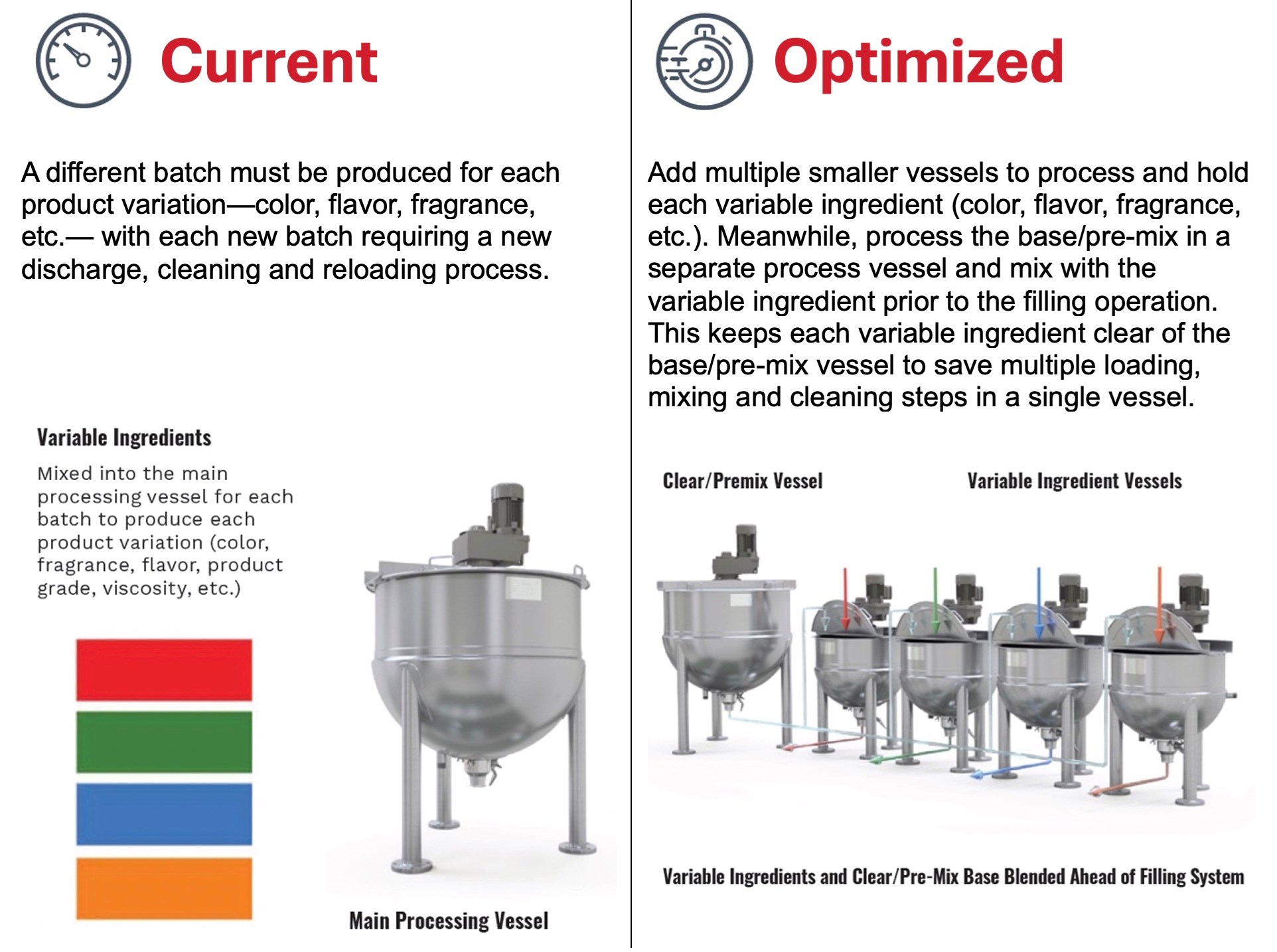
If a single batching vessel is used, a different batch must be produced for each color, flavor, etc., with extra time required to prepare the base, add in the color, flavor, etc., mix and process each batch, discharge the vessel, then clean it thoroughly to prepare for the next different batch. This process is then repeated for each product variation, multiplying each of these time-consuming steps.
SOLUTION: To gain efficiencies, the process was reconfigured into three parts:
- The main processing vessel was used only to process the product base or pre-mix.
- Multiple, smaller vessels were added to hold each individual variable ingredient (e.g., color, flavor).
- The variable ingredients were combined with the base/pre-mix prior to the filling operation in a dedicated, smaller mixing vessel at the head-end of the filling system.
With this approach, adding variable ingredients to a standard base or liquid pre-mix significantly reduced overall production time and the labor required for setup and clean-out of every batch.
Comments
Add Your Own Comment