UNIFLOW JACKET Faster, More Consistent Heating and Cooling and Longer Vessel Life
Uniquely Lee Uniflow Jacket
UNIQUELY LEE: Uniflow Jacket
When making products that require batch processing – such as food, pharmaceutical, cosmetic, and chemical products – throughput and consistency are the drivers of operational performance.
Lee’s Uniflow Jacket is specifically engineered to enhance processing throughput and consistency, by accelerating batch heat-up and cool-down times while providing an enhanced structural integrity to the tank.
Unidirectional Steam or Water Flow Means Faster Heating and Cooling Times with More Consistent Temperature Control
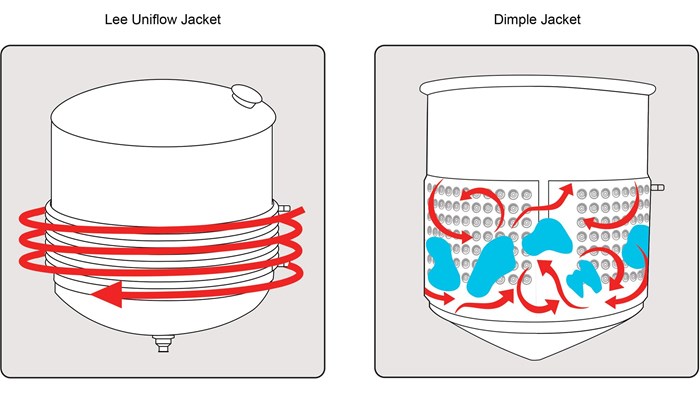
With the Lee Uniflow jacket, steam or water is delivered to the jacket inlet, and moved rapidly in a single direction, providing uniform thermal flow through a tightly wound, stainless steel coil around the side of the tank or kettle to the jacket outlet.
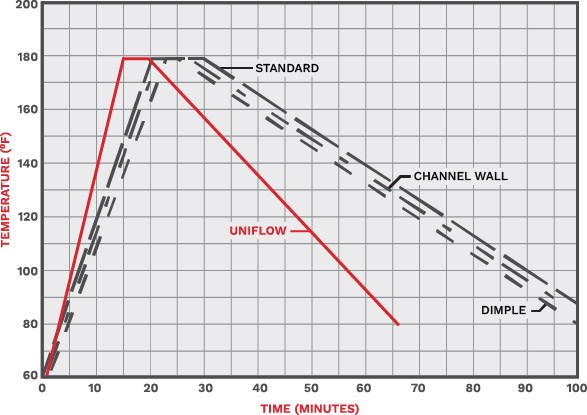
This Uniflow jacket design applies heating or cooling very rapidly and efficiently to the interior wall of the vessel, which provides up to one-and-a-half times higher heat transfer coefficient than conventional dimple jacket or channel wall construction. Moreover, the unidirectional flow eliminates air gaps and hot/cold spots that can occur in a dimple or standard jacket during each heating and cooling cycle. Uniflow-equipped vessels can therefore provide highly consistent heating and cooling in every batch cycle.
Faster and more consistent heating and cooling times translate to higher production batch rates, lower production costs and more consistent batch processing operations.
Testing comparisons of a 1,500 gallon Uniflow jacketed tank with other conventional jacket designs have shown an approximate 36% reduction in total processing time. This means that, instead of running three batches in a standard dimple or channel wall jacketed vessel, four batches could be run with the Uniflow jacketed vessel in the same time period (see chart).
Uniflow Construction Optimizes Performance and Service Life
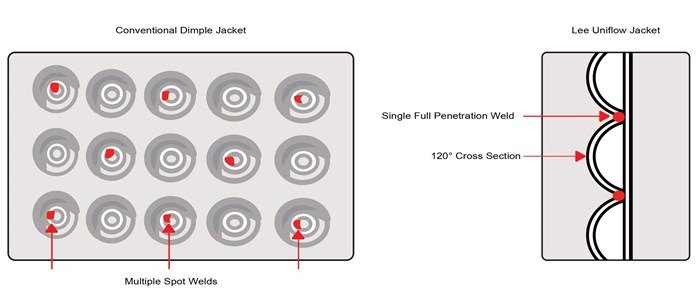
The Lee Uniflow jacket utilizes a unique 120-degree radius continuous coil which is formed and welded (full penetration) to the vessel surface. Here’s why this is such an important advantage:
Superior heat transfer:
The Lee Uniflow jacket produces significantly faster heating and cooling times because the 120-degree coil design maximizes the heat transfer surface area for steam or water. Moreover, the strength of the continuous welding used in the Uniflow jacket essentially bonds the coil and the inner shell into a single unit. With this exceptionally strong metal bond, thinner-gauge stainless material can be used for the inner shell, which increases heat transfer to the inner shell surface.
Leak-proof, long-term durability:
The continuous, full-penetration weld used in this coil design adds significant strength and structural rigidity to the vessel wall. Continuous welding also reduces the possibility of leakage inherent in the much weaker multiple spot welds used in dimple jacket designs. This approach significantly increases the strength and long-term durability of the tank or kettle, extending its service lifetime and reducing leakage risk.
With the Lee Uniflow jacket (bottom), steam or hot/cold water moves rapidly in a single direction to quickly apply heat or cooling to the jacketed sidewall of the kettle or tank. On dimple jacket tank designs (top), steam or hot/cold water flows in random directions around the tank, leading to longer heating and cooling times and creating air gaps and hot/cold spots, causing inconsistent heating and cooling of the vessel wall.
An optional feature of the Uniflow jacket can create multiple zones in the vessel, which allows for selective heating and cooling of lower and upper sections of the vessel. This makes it possible to apply direct heating/ cooling to the lower portion only when producing smaller-sized batches in a larger vessel. The Uniflow zoning option saves energy that is wasted when heating the entire vessel during smaller batches. This feature also reduces potential burn on of product, which leads to higher labor costs for additional cleaning. When producing smaller batches, there is a risk of burning product onto the side wall of the vessel above the product line if the entire vessel is being heated.
Spot Welds create significant potential for jacket leaks
Hundreds of spot welds create significant potential for jacket leaks: Multiple spot welds required for each of the many dimple sections in the jacket create hundreds of potential failure points as repeated heating and cooling cycles cause jacket walls to expand and contract, creating stresses on each and every single spot weld during each cycle.
Continuous, full-penetration weld reduces leakage risk
Continuous, full-penetration weld reduces leakage risk: Continuous, full-penetration weld bead along joined cross sections creates a permanent bond to inner vessel shell, reducing leakage risk; 120-degree coil maximizes surface contact area for vessel heating and cooling.
How the Uniflow Jacket Improves Production Efficiency and Provides Long-Term Value
Increased production:
Faster heating and cooling times reduce batch processing times, enabling more production batches per shift.
Greater batch consistency for your product:
Fast, unidirectional steam or water flow provides a more uniform heating and cooling transfer rate and surface coverage to the vessel, maintaining high product quality in batch-tobatch consistency.
Eliminates production downtime from jacket leaks:
Continuous, full-penetration weld bead reduces risk of jacket leaks found in dimple jacket designs, preventing very expensive production downtime for jacket leak repairs.
Lower ongoing service costs:
Lee Uniflow jacket construction method adds greater stability and rigidity, providing a more robust kettle with longer service life to minimize your ongoing service costs.
Jacket Leaks and Lost Downtime: Do You Know the Costs?
Jacket leaks due to broken spot welds — a common occurrence with dimple jacket designs — add significant extra costs to your operation:
Production downtime expense, as the vessel must be taken offline for days or weeks for leak repairs and pressure vessel recertification.
Opportunity cost, as customer business or new market opportunities are lost due to diminished vessel capacity.
Future, additional leak repairs: The high number of spot welds in the dimple jacket design creates many potential failure points for jacket leakage, so the initial repair is no guarantee that leakage won’t recur at other points on the vessel.
These extra costs can be considerable, and are often the consequence of trying to save nominal cost on the initial purchase of a less reliable production vessel.